Kelp Forest Ecologist

Road to Restoration

Project Overview
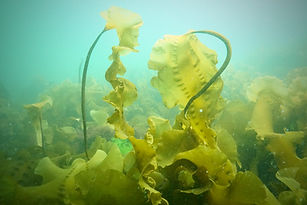
Kelp forests in Maine are under threat from multiple stressors: rapid ocean warming, increasingly frequent marine heatwaves, and the aggressive spread of turf-forming algae. Rising temperatures have already caused the collapse of kelp across southern and Midcoast Maine, creating space for filamentous red algae to dominate these once-productive reefs. Once kelp disappears and turf algae take over, our research shows that these red algal turfs release bioactive compounds that prevent young kelp from re-establishing—locking the ecosystem into a degraded state. Together, these stressors create a powerful barrier for kelp forest recovery in the Gulf of Maine. This project seeks to understand whether, and under what conditions, kelp can recover within this transformed ecosystem.
This project brings these challenges together under a unified scientific framework. We are identifying the specific chemicals turf algae use to suppress kelp and determining how these compounds affect each kelp life stage. Simultaneously, we are collecting, preserving, and identifying thermally tolerant kelp populations from across the coast of Maine. By integrating these allelopathy and thermal-tolerance experiments, we can test whether certain kelp genotypes possess dual resilience to both turf-derived chemical inhibition and the future ocean temperatures projected for the Gulf of Maine. Through a combination of metabolomics, toxicology experiments, genomics, and thermal-tolerance assays, we aim to reveal the mechanisms that prevent kelp recruitment and the traits that allow some strains to persist.
Our ultimate goal is to convert this knowledge into effective restoration tools. By pinpointing harmful compounds, identifying chemically and thermally resilient kelp strains, and designing field experiments that neutralize turf impacts, this project will build the foundation for new, science-based approaches to kelp recovery. The Gulf of Maine will serve as a natural model system for understanding—and reversing—turf-dominated states, enabling us to develop strategies applicable to threatened kelp ecosystems worldwide.
Quick Links
Funding
Institutions


Objectives

1: Identify and characterize the chemical barriers preventing kelp recovery.
• Elucidate the specific turf-derived “killer compound(s)” responsible for kelp inhibition.
• Determine lethal impacts on kelp spores, gametophytes, and juvenile stages.
• Quantify sub-lethal effects that impair growth, development, or recruitment.
2: Find and preserve kelp capable of withstanding a warming Gulf of Maine
• Collect, identify, and preserve thermally tolerant kelp genotypes from across Maine.
• Test early life stages through controlled thermal-challenge experiments.
• Build a long-term biobank to support both wild restoration and aquaculture resilience.
3: Understand how warming and allelopathic chemicals interact and use that knowledge to restore kelp
• Determine how temperature and turf-derived chemicals jointly affect kelp survival.
• Identify kelp genotypes resilient to both stressors.
• Apply these insights in pilot, small-scale restoration trials to jump-start kelp recovery.
The Team
This project is powered by an interdisciplinary team spanning the University of Maine, Bigelow Laboratory for Ocean Sciences, and the University of California–Riverside. Together, we bring expertise in coastal ecology, kelp biology, microbial and chemical interactions, metabolomics, genomics, climate resilience, and restoration science. Our group combines fieldwork, experimental ecology, high-resolution chemical analytics, and advanced molecular tools to tackle the complex biological, chemical, and climate-driven barriers to kelp forest recovery.

Dr. Damian Brady
(PI)
University of Maine

Dr. Douglas Rasher
(Co-PI)
Bigelow Laboratory for Ocean Sciences

Dr. Danial Petras
(Co-PI)
University of California Riverside

Dr. Shane Farrell
(Post-Doc)
University of Maine

Adam St. Gelais
(PhD Candidate)
University of Maine

Sara Lacourciere
(Seaweed Technichian)
University of Maine

Phoebe Churney
(Masters Student)
University of Maine
Project Updates!
September 2025: Kelp Collections
At the eastern most edge of the continental United States, the first sunrise of each day illuminates coastlines that may hold part of the solution for sustaining Gulf of Maine kelp forests. In September 2025, our seaweed lab traveled the length of the Maine coast to collect sugar kelp (Saccharina latissima) reproductive tissue from populations spanning the full range of thermal conditions found in Maine waters.
We sampled kelp from warmer southern sites—including sheltered coves and exposed rocky headlands—through to colder northern locations where kelp continues to persist despite rapid ocean warming. At each site, we collected sorus (reproductive tissue) from healthy adult kelp growing in the lower intertidal zone, habitats that are increasingly vulnerable to climate-driven stress.
Reproductive material from across this thermal gradient was transported back to our laboratory in South Bristol, Maine, where spores were released and cultured to produce haploid gametophytes. These microscopic life stages can be maintained long-term in a kelp biobank, preserving genetic diversity from across more than 3,000 miles of Gulf of Maine tidal coastline.
Biobanked gametophytes are now being used in controlled thermal tolerance experiments to identify kelp populations with heightened resilience to warming. This work—including the experimental workflow shown in the schematic below—forms the core of Phoebe’s master’s thesis, where she is quantifying variation in survival, fertility, and physiological performance under simulated heat stress. Together, these efforts support science-based kelp restoration strategies and inform the future of both wild kelp forests and seaweed aquaculture in the Gulf of Maine.
Written by Phoebe Churney


November 2025: Turf Collections and Chemical Extraction
After a long field season spent collecting kelp sorus tissue up and down the Maine coast, our team has shifted gears. This fall, we turned our attention to a very different kind of seaweed—one that has come to dominate many of the reefs where kelp forests once thrived.
Our focus is on Dasysiphonia japonica, a filamentous red alga native to the Pacific that has become invasive in the northwest Atlantic. In the Gulf of Maine, rapid ocean warming has driven widespread kelp forest collapse, and on many southern Maine reefs, D. japonica has rushed in to fill the void. Today, it commonly blankets 50–90% of the seafloor in these areas, replacing structurally complex kelp forests with low-lying turf and a sharp reduction in ecosystem services such as habitat provision and carbon storage.
What makes this species especially concerning is not just how much space it occupies, but what it releases into the surrounding water. Previous work suggests that filamentous turf algae can exude bioactive compounds that inhibit kelp recruitment and survival, reinforcing turf dominance and locking reefs into a degraded state. To understand this chemical dimension of reef collapse, we need the turf itself—lots of it.


Our goal was ambitious: hand-collect nearly 10 kilograms of turf algae, transport it back to the lab, incubate it in sterile seawater, and capture the dissolved chemicals it releases into the water. On a crisp fall morning, our dive team—Phoebe, Colby, Liz, and me—set out with Captain Peter Craig to what we jokingly called the “turfiest” site we could find: Damariscove Island, just offshore from the mouth of the Damariscotta River.
Damariscove has a long history as a living laboratory for researchers at the Darling Marine Center. From Bob Steneck’s foundational kelp forest surveys to Richard Wahle’s lobster research, this small island has anchored decades of ecological monitoring. I’ve used it myself over the years to pilot new projects, revisit historical sites, and extend long-term datasets. What makes it especially striking now is how dramatically it has changed: 10–15 years ago, much of this reef was nearly 100% kelp. Today, it supports some of the most turf-dominated reefs in the region.
Damariscove did not disappoint. Within just two dives, the four of us collected nearly 15 kilograms of Dasysiphonia—more than enough to fuel the next phase of the project.
Back at the Darling Marine Center, the real work began. Phoebe and I spent nearly 10 hours in a 12 °C incubator meticulously washing the turf algae to remove epiphytes and small invertebrates before transferring it into artificial seawater. The goal was simple in concept but demanding in practice: isolate the chemistry released by the algae itself.
After several hours of incubation, we began extracting the waterborne metabolites—the dissolved compounds exuded by the turf—using solid phase extraction. Over the course of about six hours, we pushed roughly 45 liters of seawater through our cartridges, slowly concentrating an invisible chemical fingerprint that may help explain why kelp struggles to return once turf takes over.
The next steps take us from field ecology into chemical ecology and experimental biology. We’ll elute the chemistry from the cartridges and begin running bioassays using our new high-throughput fluorescent microscope, testing how these compounds affect kelp gametophytes at their most vulnerable life stage. Somewhere in that chemical mixture may be the mechanisms that help turf algae maintain dominance—and understanding them is key if we hope to restore kelp forests in a rapidly warming Gulf of Maine.
Written by Shane Farrell

